

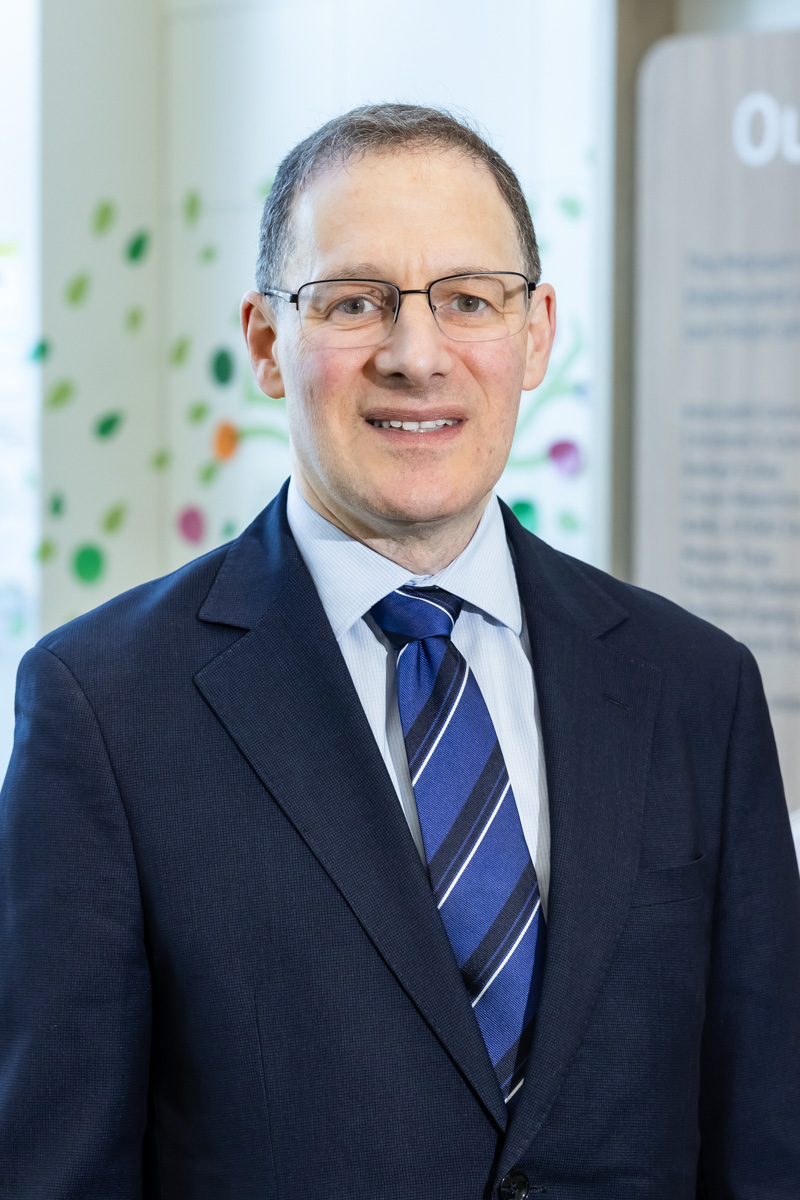
After an extensive international search, in late 2025 Professor David Eisenstat stepped into the inaugural role of Children’s Cancer Foundation and My Room Children’s Cancer Charity Chair in Childhood Cancer – a role supported by a $12 million investment drawing equally from the Children’s Cancer Foundation and My Room ($6 million combined) and from partners MCRI, The Royal Children’s Hospital, the RCH Foundation, and the University of Melbourne.
We sat down with Professor Eisenstat to hear his vision for the role and what it could mean for children with cancer across Victoria and beyond.
Professor Eisenstat describes his role in clear terms. “The Chair in Childhood Cancer has three major roles,” he explains. The first is maintaining a leading research program of his own – building on the idea that some childhood cancers, particularly brain cancers, are fundamentally disorders of normal development. “We can harness principles of development towards generating novel treatments,” he says.
The second dimension is working closely with the Department of Paediatrics at the University of Melbourne, the Children’s Cancer Centre at the RCH, MCRI, and the RCH Foundation to strengthen the integration of research within childhood cancer at the Melbourne Children’s Campus. The third is connecting that campus to a broader ecosystem of partners – from the Parkville Precinct institutions and Children’s Cancer CoLab to philanthropic supporters like the Children’s Cancer Foundation and My Room Children’s Cancer Charity.
Despite genuine progress, with more than 80% of children diagnosed with cancer now surviving at least five years. Professor Eisenstat is clear about what remains unresolved. Outcomes for recurrent, refractory, or relapsed disease remain poor for many childhood cancers. Some, like diffuse midline gliomas (DMG), carry a survival rate of less than 1%.
“There is an urgent unmet need for new therapies,”
Promising approaches such as targeted therapies and immunotherapies, including CAR T-cells, are largely focused on adult cancers, which are biologically distinct from those in children. Funding and support for paediatric-specific treatment development remains insufficient. Professor Eisenstat also highlights the importance of childhood cancer biobanks and patient outcome registries, such as the Victorian Children’s Cancer Outcomes Registry (VCCOR), and connecting these to national and international databanks to learn from every child’s experience.
Prior to taking the Chair role, Professor Eisenstat served for five years as Director of the Children’s Cancer Centre at the RCH and co-led the Medical Research Futures Fund supported Victorian Paediatric Cancer Consortium alongside Professor Ron Firestein from 2021-2024. He is also a member of the VCCC Alliance Board and its Cancer Research Advisory Committee.
“I am familiar with many of the stakeholders and funding partners of the Chair, as well as the clinical and translational researchers within the Victorian childhood and adolescent and young adult oncology community,” he says.
“Together, we have an excellent foundation on which to build the Cancer Flagship at MCRI, establish improved interdepartmental and multidisciplinary collaborations, and support our community of childhood cancer researchers in Victoria and beyond.”
Sustaining the research pipeline is one of the Chair’s central priorities. Professor Eisenstat describes the challenge as complex: identifying and retaining talented clinician-scientists requires not only fellowship funding but also part-time clinical appointments in the public hospital system to complement research stipends.
He points to several encouraging initiatives – Clinical Research Fellowships from My Room, the Children’s Cancer CoLab Future Leaders program supported by the CCF, and MCRI Clinician-Scientist bridge and fellowship awards – as a foundation to build on. “Strategic investment in training and retaining the next generation of investigators, with leveraged funding for positions in the public hospital sector, will build on these current initiatives,” he says.
Looking to the next five years, Professor Eisenstat identifies several research areas most likely to have a big impact. Immuno-oncology – including CAR T-cell therapies for solid tumours such as brain tumours, sarcomas, and neuroblastoma, as well as AML – stands out, alongside pharmacogenomics to identify patients at risk of serious adverse effects from treatment.
He also flags patient-reported outcome measures (PROMs) in clinical trials, functional genomics to identify vulnerabilities in relapsed disease, and sustained investment in discovery research for diseases like DMG where no standard treatment beyond radiotherapy currently exists.
Success in this role, Professor Eisenstat says, goes beyond traditional metrics like publications and grant funding. “I want to get people excited about the promise and potential of childhood cancer research and how everyone can make a contribution by joining and thereby expanding our community of researchers.”
“I want to get people excited about the promise and potential of childhood cancer research and how everyone can make a contribution by joining and thereby expanding our community of researchers.”
His ultimate vision is a productive ecosystem of paediatric cancer experts across the Melbourne Biomedical Precinct, positioning Melbourne as a global leader in childhood cancer research while improving outcomes for the children who need it most.


Copyright 2026 Children's Cancer Foundation
ABN: 96 114 942 415
